Article: Microplastics and Nanoplastics in Atheromas and Cardiovascular Events
Authors: R. Marfella and colleageues
DOI: 10.1056/NEJMoa2309822
What We Already Know:
Plastics have been integral in the development of modern society and ubiquitous in everyday life. In the 1950s, there were fewer than 2 million tons of plastics manufactured, whereas now over 400 million tons are manufactured across the globe yearly — this number is slated to triple by 2060. It’s not all together surprising when you consider that fossil fuels are the primary input for plastic production, and we all know how fossil fuel usage has increased at a similar clip over the past decades.
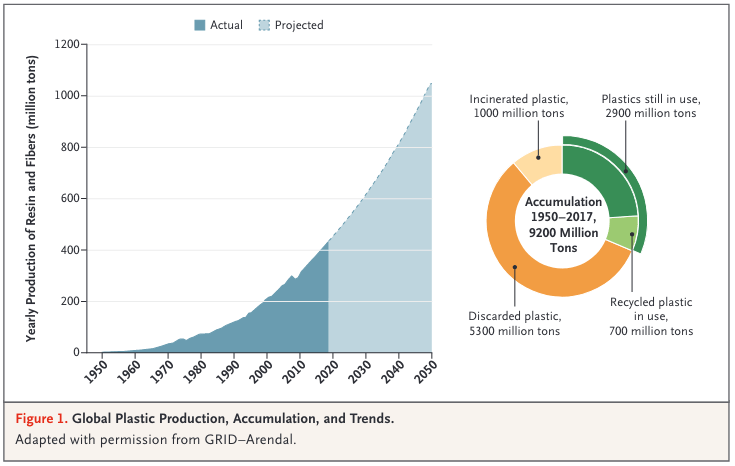
(source: DOI: 10.1056/NEJMe2400683)
In nature, regular plastics degrade to microplastics (<5mm) and nanoplastics (<1000nm) (MNP), which due to their small size, are liable to enter the human body by way of ingestion, inhalation, and even absorption through the skin. MNPs have been found in various parts of the body including but not limited to the placenta, lungs, liver, breast milk, urine, and blood.
Preclinical studies (i.e. studies that precede those in humans themselves) show that the presence of MNPs causes “oxidative stress, inflammation, and apoptosis in endothelial and other vascular cells; animal models support a role for MNPs in altered heart rate, cardiac function impairment, myocardial fibrosis, and endothelial dysfunction.” However, no study thus far has linked the presence of plastics inside the human body and any objective clinical outcome (heart attacks, strokes, etc.), so whether these plastics are clinically relevant is unknown.
What Was Done:
As people may or may not know, cholesterol plaque buildup (also called atherosclerosis) is central to the development of the biggest drivers of death and disability in humans, which include heart attacks and strokes. These deposits of cholesterol (and eventually immune cells, smooth muscle cells, and ultimately, calcium) originate as early as people’s teens, grow over years, and unfortunately lead to the demise of more patients than any other entity in the human body (more than neurodegenerative diseases and cancers).
In a pretty ingenious study design, the authors found way to easily parse out which patients had high levels of plastics in their cholesterol plaques and who did not, they:
- screened adults who were undergoing endarterectomies (procedures where surgeons cut into your neck, open your carotid artery, and scoop out plaques that would otherwise put you at high risk for strokes)
- evaluated those plaque samples for the presence of microplastics and nanoplastics (using mass spectroscopy, electron microscopy, and stable isotope analysis — see figure below)
- followed these patients for ~3 years to compare the incidence of cardiovascular events

(source: DOI: 10.1056/NEJMoa2309822)
What They Found:
Of the 257 subjects included in the study, 150 were found to have evidence of MNPs in their plaques whereas 107 did not. The most common plastics found were polyvinyl chloride (A.K.A. PVC, as in PVC pipes) and polyethylene.
Punchline: subjects that had any level of microplastics/nanoplastics inside their cholesterol plaques had a 4.53x higher risk of later suffering from a composite endpoint of nonfatal heart attacks, nonfatal strokes, and death by any cause (hazard ratio, 4.53; 95% confidence interval [CI], 2.00 to 10.27; P<0.001; see below).

(source: DOI: 10.1056/NEJMoa2309822)
Also, patients in the plastics group had higher levels of inflammatory markers expressed in their plaques that moderately correlated with the amount of plastic present. Lastly, (amongst other things) the electron microscopy imaging identified literal plastic molecules in the plaques themselves. You can see them both in and outside macrophages (immune cells that normally only react to cholesterol molecules found in endothelial walls) below.

Why It Matters:
- This is the first time anyone has directly linked the presence of plastics inside humans and cardiovascular disease — or any concrete clinical outcome for that matter. A nearly 5x increase in heart attacks, strokes, and mortality (cumulatively) is not subtle, especially when you consider there was an increase in inflammation directly in the plaques where the plastics were found. Not to mention, the electron microscopy literally showed macrophages that had ingested foreign plastic molecules. Macrophages primary job is to engulf and remove foreign materials like bacteria, viruses, and toxins.
Sure, this wasn’t a randomized, double-blind, placebo-controlled trial where hundreds of millions of dollars are spent to administer microplastics or placebo to thousands of subjects and then follow them for years to compare rates of heart disease occurrence (which would be HIGHLY unethical). In other words, the authors DID NOT PROVE CAUSALITY. There very well could have been confounding factors like socioeconomic status, diet, etc which not only exposed subjects to more micro/nanoplastics but also made them susceptible to heart disease. That said, it’s hard to ignore the signal found in this study. - Polyvinyl chloride and polyethylene are…everywhere. A quick search online, gives you the following:
- Food Packaging and Wrapping Film (cling films and plastic wraps)
- Bottles and Containers: plastic bottles and containers, especially those for oils and non-food items (less commonly for water/soft drink bottles which are typically made from PET). High-density polyethylene (HDPE) is commonly used in milk jugs, juice containers, and water bottles due to its strength and chemical resistance.
- Kitchen Utensils: spatulas, serving spoons, and measuring cups
- Gloves
- Tubing for Beverage Dispensers
- Coatings for Metal Cans: Certain types of metal cans (like those for preserved foods) have interior coatings that might contain PVC.
- Plastic Bags
- Cereal Box Liners
- Food Containers and Tupperware
- Squeeze Bottles
- Freezer Bags and Zipper Storage Bags
- OTHER non-food-related items: Pipes and plumbing, medical devices (IV bags, tubing, blood bags, dialysis equipment), clothing: raincoats/jackets/boots, furniture/upholstery, toys
- You know that time when you tasted plastic while drinking coffee out of that new plastic thermos/mug you bought from Amazon?…Yeah, well you should pay attention to that. As is frequently the case in other areas of medicine (and life, for that matter), there are rarely ever solutions — just tradeoffs. Plastics are cheap and easy to make, but their use in almost every major sector across the globe was going to cost us something eventually. It’s possible that part of that cost may just be in the form of human morbidity and mortality. They’re also destroying the planet, but I digress.
While we don’t know exactly how the subjects in the study with cholesterol plaques laden with micro/nanoplastics end up with those plastics there, I hypothesize that the majority were unknowingly ingested by way of being in contact with foods (or breathed in in the form of Particulate Matter 2.5, but more on that another time…). Assuming this is true, it would probably be in our best interests (at least until someone disproves this theory) to avoid foods in plastic containers as much as possible.

 Sid Parihar, MD
Leave a comment